
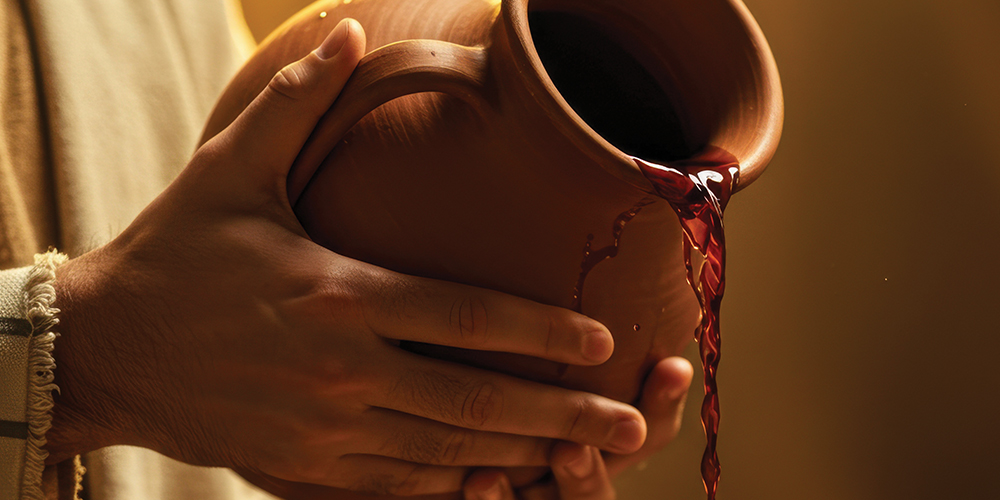
Like the burnt offering, drink offerings seem to have been offered before the giving of the Mosaic law. The first mention in Scripture of a drink offering is when Jacob returned to Bethel. While fleeing from his brother, the Lord had appeared to him in a dream (Gen. 28:17), confirming the covenant He had made with Abraham and later confirmed with Isaac. At that time, Jacob named the place “Bethel,” meaning “house of God.” Many years later, in obedience to the Lord, Jacob returned to Bethel and built an altar (Gen. 35:7). He named the place “El Bethel,” the God of Bethel, demonstrating that he had come to know the God of Bethel more deeply through both experience and direct revelation (Gen. 31:13). He now appreciated the Person more than the place. Later, after the Lord promised to give him the land He had guaranteed to Abraham and Isaac, Jacob poured a drink offering onto a pillar of stone, and then anointed it with oil (Gen. 35:14).
Wine, used for the drink offering, is symbolic of joy (Jdg. 9:13), and the act of pouring it out signified a deep sense of worship and thanksgiving. Later in Israel’s history, when the Lord judged His people for their idolatry, He rebuked them for pouring out their drink offerings to foreign gods (Jer. 7:18). Conversely, it was a time of joy when the drink offering of wine was poured out to God.
The drink offering is not mentioned again until the giving of the Law after the Lord had redeemed Israel out of Egypt. However, in the introduction of the five Levitical offerings with detailed instructions (Lev. 1-7), the drink offering is not mentioned. Even later, no specific instructions are given other than the measurement of wine to be used. The drink offering prescribed in the Mosaic Law, foreshadowed the joy which both God and man find in Christ Jesus.
Normally offered with the meal and burnt offerings, the drink offering was performed by completely pouring out a quantity of wine, at the base of the altar. None of it was to be consumed; it was all for God. A supplemental offering under the Mosaic Law, it was never commanded apart from a sacrifice.
The Lord instructed Moses that after the children of Israel entered the land, when anyone, whether native-born or alien, brought a burnt offering as a freewill offering, or for the appointed feasts (Lev. 23:13; Num. 28:16-29:40), or to fulfill a vow (Num. 6), or for the Sabbath and monthly offerings (Num. 28:9-15), they were also to bring a meal (grain) and drink offering. The amount of wine for the drink offering varied according to the size of the animal one chose to bring: one-fourth of a hin for a lamb or young goat; one-third of a hin for a ram; and one-half of a hin for a young bull (Num. 15:1-16). Estimates of the modern equivalency for a hin vary from about four to eight quarts. One-sixth of a hin was a day’s supply of drinking water.1 Similarly, the greater our sacrifice for the Lord, the deeper our appreciation will be of Him and greater will be our joy. The Lord takes great pleasure in us when we offer ourselves up as a living sacrifice in our service for Him (Rom. 12:1-2).
The Lord Jesus is our greatest example for He delighted in completely doing His Father’s will. Even though it meant the cross He said, “Behold, I have come to do Your will, O God” (Heb. 10:9). Completely pouring out the contents of the drink offering symbolized Christ’s complete surrender (Isa. 53:12). Since wine is symbolic of joy; in this context, it represents the absolute joy that the Son brought the Father through His sacrificial, obedient service.
Drink offerings of one-fourth of a hin of wine were to be offered daily with the morning and evening burnt offerings (Ex. 29:38-42; Num. 28:1-8). The burnt offering was entirely for God. The continual burnt offering typified Christ’s constant and uninterrupted devotion to His Father during the entirety of His first advent (Isa. 53:12; Eph. 5:2; Phil. 2:8; Heb. 9:14; 10:7-9) and the drink offering symbolized the joy accompanying it.
Drink, burnt, and grain offerings were presented with the sin offering for unintentional sins, “then it will be, if it is unintentionally committed, without the knowledge of the congregation, that the whole congregation shall offer one young bull as a burnt offering, as a sweet aroma to the LORD, with its grain offering and its drink offering, according to the ordinance, and one kid of the goats as a sin offering…And if a person sins unintentionally, then he shall bring a female goat in its first year as a sin offering.” (Num. 15:22-31). Our faithful High Priest knows our weaknesses and when He makes us aware of sin, a peaceful joy follows upon confessing it, knowing He will always forgive and cleanse us from all unrighteousness (1 John 1:9).
The amount of wine offered in the drink offering was the same as the measurement of oil used in the grain offering (Num. 15:4-10). In His spotless life and in His death, Christ was always in perfect fellowship with the Father and the Spirit. After His baptism, the Lord was anointed by the Holy Spirit for ministry with His Father’s full approval (Matt. 3:16-17). John 3:34 says, “For He whom God has sent speaks the words of God, for God does not give the Spirit by measure.” Christ was anointed by the Holy Spirit in a way unlike any other person and the Father gave testimony to the pleasure He found in His Son. The Old Testament prophets and other individuals (Ex. 31:1-11) were temporarily anointed by the Spirit for specific purposes. Today, we know the help of the indwelling Spirit in ministry and in life, but none of us has ever had such a Spirit-filled ministry as Christ. Our omniscient Lord spoke the very words of God and demonstrated through His words, actions, and the whole tenor of His life that He was the wisdom and power of God (1 Cor. 1:24).
While sitting in prison, Paul rejoiced at the possibility that he might be poured out as a drink offering upon the Philippians’ sacrificial service (Phil. 2:17). Then, a few years later, again in prison, Paul viewed his impending martyrdom as a drink offering poured out to God at the base of his many years of sacrificial service (2 Tim. 4:6-8). Looking back on our lives, can we likewise look forward to our departure with confidence and joy?
The Lord Jesus personified the drink offering more than any other person. The prophet Isaiah said the Lord poured out His soul unto death (Isa. 53:12). Indeed, He shed His blood for us (Luke 22:20); He was poured out like water (Ps. 22:14); and He “made Himself of no reputation” temporarily veiling the visible manifestation of His glory (Phil. 2:7-8). The Lord Jesus demonstrated the joy of obedience in a way no other person ever did or could. It was not only a future joy awaiting Him in His glory (Heb. 12:2), but also a present joy in His suffering. He learned obedience through His suffering (Heb. 5:8), and He delighted to do the Father’s will (Ps. 40:8). In spite of the cruelty He endured from man, He knew that His offering to God was accepted and that it would bring redemption to those who believed upon Him. He was truly God’s drink offering. Knowing this, He refused the wine offered to Him on the cross (Mark 15:23). The drink offering was not to be consumed but to be poured out.
We will experience the deepest joy during difficult times if we submit to His will. The knowledge of His will gives meaning to our circumstances and leads us to thank God for the hour He has given us. Like Christ, we can find joy in our suffering as we obey Him and anticipate our future joy in glory (Rom. 8:18).
ENDNOTES
1. The Baker Illustrated Bible Dictionary (Grand Rapids, MI: Baker Publishing Group, 2013), Olive Tree Electronic Edition