
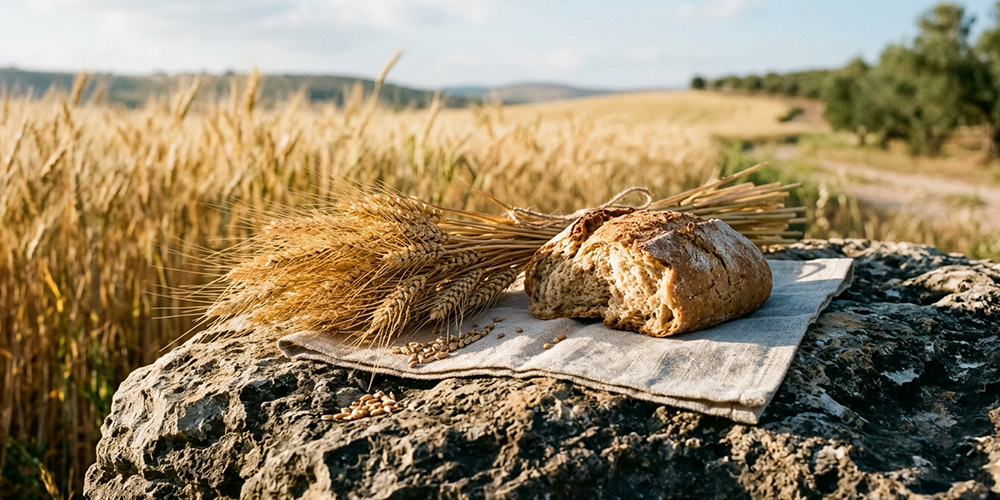
In the wilderness after the Exodus, the Israelites complained to Moses and Aaron about their lack of food. Their complaint is recorded in Exodus 16:3: “And the whole congregation of the people of Israel grumbled against Moses and Aaron in the wilderness, and the people of Israel said to them, ‘Would that we had died by the hand of the LORD in the land of Egypt, when we sat by the meat pots and ate bread to the full, for you have brought us out into this wilderness to kill this whole assembly with hunger.’”1 The Lord responded to their need by providing quail on this occasion in the evening, and by continuously providing manna from heaven each morning (vv.13-15, 35).
This theme of hunger and miraculous bread in the wilderness appears again in the New Testament. Once more, a questioning and doubtful crowd brings its complaint, this time to the One who is greater than Moses, the Lord Jesus Christ. They ask Jesus to prove His authority by pointing back to the Exodus: “So they said to him, ‘Then what sign do you do, that we may see and believe you? What work do you perform? Our fathers ate the manna in the wilderness; as it is written, ‘He gave them bread from heaven to eat.’” (John 6:30-31).
The truth was that Jesus had already given them a sign. By feeding them bread, He had demonstrated that He was greater than Moses. Yet the physical bread was not the main issue. Jesus Himself was all-important, for He is the source of spiritual life. So, Jesus said to them, “Truly, truly, I say to you, it was not Moses who gave you the bread from heaven, but my Father gives you the true bread from heaven. For the bread of God is he who comes down from heaven and gives life to the world” (John 6:32, 33).
He was talking about Himself. Jesus could do much more than multiply the bread. He was the Bread, the true heavenly bread that gives life to the world. Perhaps the crowd thought they would stump Jesus by referring to bread in the wilderness and asking for a miracle from Him. That challenge had already been tried by someone far more crafty and devious than they were. Where did Satan do that? In the wilderness.
On that occasion, Jesus was led up by the Spirit into the wilderness to be tempted by the devil (Matt. 4:1-4). When Jesus was hungry after fasting forty days and forty nights, the tempter came and said, “If you are the Son of God, command these stones to become loaves of bread.” Jesus answered, “It is written, ‘Man shall not live by bread alone, but by every word that comes from the mouth of God.’” In this and every subsequent temptation, Christ answers with Scripture, quoting Deuteronomy 8:3, 6:16, and 6:13.
Christ is the Bread of life from heaven. He is the source of eternal life and is all that we need. The whole Bible is about Him. In the Old Testament Jesus’ coming as Savior is “expected.” In the gospels His glory, suffering, and sacrifice are “exhibited.” In the epistles His way of salvation by faith is “explained.” Then in the book of Revelation His majesty as King is “exalted.”
That is far more than we could hope for or expect. “What no eye has seen, nor ear heard, nor the heart of man imagined, what God has prepared for those who love him—these things God has revealed to us through the Spirit.” (1 Cor. 2:9-10) Our hearts can feed on that forever!
Endnotes
1. All Scripture quotations are from the ESV.