

Some of the most pivotal teachings the Lord Jesus ever gave to believers were delivered to those first disciples in the Upper Room, just hours before He would die. As recorded for us in John 13–17, the Master was preparing them to carry on and thrive as His witnesses—with joy—after He left and the Holy Spirit was sent.
Technically, they were in the Upper Room only until the close of chapter 14, Judas having left in chapter 13. The Master spoke the words of chapters 15 and 16 as they walked toward, and then out of, the east side of the city, where He stopped and prayed to the Father on behalf of His followers (including us), as recorded in chapter 17.
Please take a moment to read John 15:1-17; however, we will be primarily focusing on verses 1-8.
Christ’s Priority on Fruit-Bearing
Let us first address the expressions “cuts off” (v.2, NIV) or “takes away” (v.2, NKJV), and “thrown away… and… burned” (v.6, NIV). Some use these verses to teach that we can lose our salvation. However, salvation is not the context here. Rather, these verses are about living life as an effective disciple. The Lord’s inclusion of these comments underscores His priority on fruit-bearing by contrasting it with our not being useful in the way we were meant to be (see 2 Pet. 1:8-9; Titus 3:14). Years later, Paul would teach a similar principle using a different illustration, where salvation is assured, but the work may or may not be what it was meant to be (1 Cor. 3:10-15).
Note three key motives the Lord Jesus gave disciples for prioritizing fruit-bearing:
- For the Father’s glory (v.8). This should be our greatest motive. After all, as the Vinedresser/Gardener, He deserves to see His efforts succeed, just as they did in Christ (John 17:4)
- To “prove to be” disciples of the Lord Jesus (v.8, NASB). This is consistent with what He had taught in 13:35. An unfruitful branch lacks credibility in claiming to be a Christian, since they are not following Christ well. No one is benefitting from them in the way God intended, though He could still make use of them for firewood (v.6)
- The assurance of hearing “Yes” to our prayers (vv.7,16). Our Father always hears and answers the prayers of His children, but He does not necessarily agree with the content or motives of our prayers (e.g. Jam. 1:5-8; 4:2-3). Believers of mature character and a lifestyle of intimacy with Christ have come to truly delight themselves in the Lord, so that they express in their prayers the very will and heart of the Lord Himself, and He delights to give them those desires (Ps. 37:4).
In epistles addressed to the churches, the Spirit of Christ continues to emphasize fruit-bearing as our norm. For example, see Romans 7:4 and Colossians 1:10, as well as Acts 26:20 (echoing the Baptizer in Luke 3:8). This leads to a natural question.
What Is “Fruit”?
Most likely, we immediately and rightly think of “the fruit of the Spirit” (Gal. 5:22-23), since the life of the vine flowing through us is meant to produce Christlike character. We will return to this point in a moment.
The context in John 15, however, is about being equipped to live out the life into which the Holy Spirit will lead believers, as witnesses for Christ while we await His return. Therefore, we could say that ‘fruit’ refers to a productive lifestyle—a harvest—in our efforts as ambassadors for Christ. This is reflected in a sample of passages in the New Testament where the word “fruit” is used:
- Evangelism and discipleship (Rom. 1:13; Matt. 28:18-20) Note of caution: it is about contributing to these activities, not about numbers of converts or disciples
- Sharing materially with fellow believers in need (Rom. 15:26-28)
- The sacrifice of praise to God, with thankfulness, especially while being persecuted (Heb. 13:13-15)
- Deeds which come from being rooted in Christ and the truth (Matt. 7:15-23; 12:33-37). It is not just religious works and experience. It must come from a healthy, vital communion with Christ
- “The fruit of righteousness” (e.g. Jam. 3:18; Heb. 12:11; Phil. 1:11; Eph. 5:9) – living in step with God, as to what is right in action and heart
The reality is that what is happening within us is more crucial than the outward actions on which we might be tempted to focus, perhaps even with a sense of pride. The deeds of Christ were an outworking of His perfect character – “the fruit of the Spirit” – and He continues to seek to live out these qualities through His followers.
Side Notes of Encouragement:
- Take comfort: it is not instant; it is a developmental process, though growth and increasing maturity are intended
- Take the pressure off: we are called to “bear” fruit, not “produce” it. The word “produce” carries a more causal meaning, as if we were the source. However, Christ makes it clear a branch cannot generate fruit. It is the life of the vine flowing through us that brings forth the fruit
The Secret of Bearing Abundant Fruit
In this passage, we often focus on the vine, the branches, and the fruit. However, notice verse 1: behind it all stands the Father, the expert Gardener and Vinedresser, who provides all the conditions necessary for success. He is seeking to bring about a progression of growth:
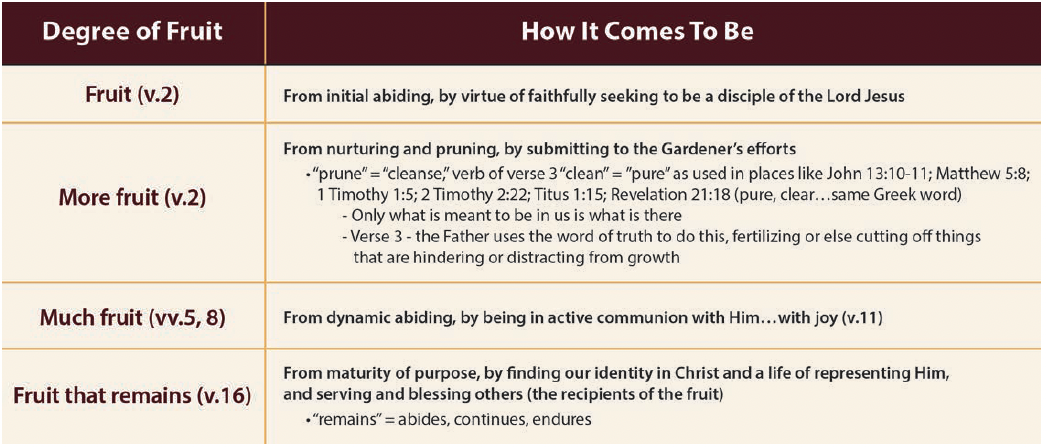
The secret to such growth is to focus on our responsibility—abiding—rather than on the fruit itself. The word “abide,” whether used as a verb or a noun, appears nearly 20 times in John 14 and 15, including John 14:2, which states, “In my Father’s house there are many abodes.” (Darby) By abiding, we are passive and dependent, because the fruit is produced by the Vine and the Gardener, not by us. Yet, this process is also active and intentional (2 Pet. 1:3–11), as we must prioritize our connection to the Vine and cooperate to ensure there is an unhindered flow of the life of the Vine through us. Only then can we be confident that mature fruit will appear and yield ongoing, high-quality harvests.
In conclusion, we might paraphrase verse 8 in this manner: “By this My Father, the Gardener, is glorified: that you bear a reliable abundance of fruit and thereby demonstrate that your outflow of life and purpose is truly My life and My will expressed through you.”