
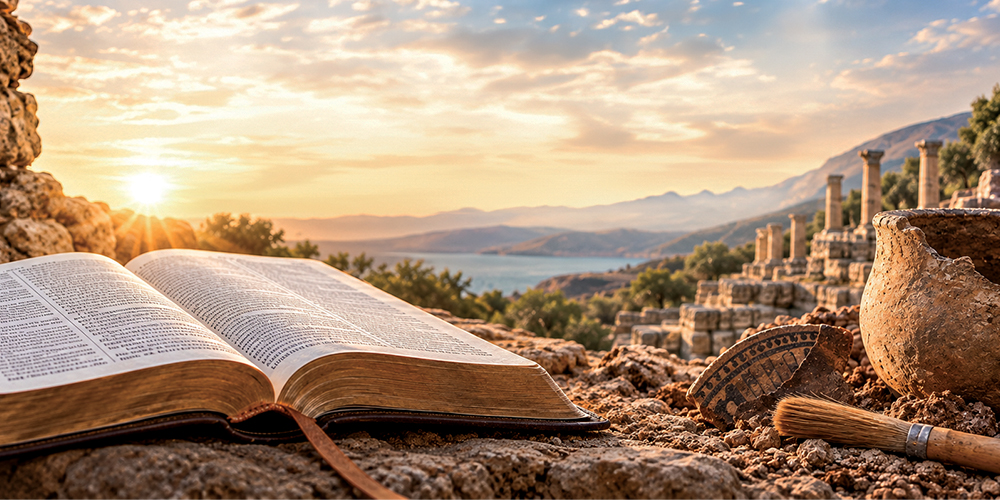
Sun, heat, and dirt. When I think about my first archaeological excavation, these three elements come immediately to mind. I remember sitting on the dusty earth under the scorching sun, sweating from the heat of central Israel in early summer. Trowel in hand, I scraped away soil from our excavation square, uncovering a world hidden by time. As I excavated the ground along what would have been the ancient outer wall of the biblical city of Shiloh, the awe of my task swept over me. I was pulling artifacts out of the ground that had not been seen or handled for thousands of years.
Later that morning, I was given the task of washing debris at the wet sifting station. The inclusion of water was a welcome break from the sun, heat, and dirt. I was at a long metal trough that had several sprayers. I was to take mesh bags of what had been excavated in the squares further up the mound, dump them into a sifting tray, and spray off the debris with water. The goal was to find anything that might have been missed in excavation or dry sifting.
I will never forget the wonder I felt when, after spraying off one particular bag of rubble, I saw a previously dirty and clay-colored stone turn bright white. As I picked up the stone, I saw that one side resembled the backside of a beetle, and the other side was flat with pictographs. I had found an ancient Egypt scarab. The professional archaeologists on site recorded the find and sent it off to be further analyzed. Much later, I was informed that the scarab I had discovered had come from the Hyksos period in Egypt, the time just before the exodus and conquest. This small item I discovered was one more extrabiblical confirmation of the Bible’s reliability.
You might be wondering, what is archaeology and why is it important for studying the Bible? Simply put, archaeology is the discovery and analysis of the remains of ancient peoples, whether individuals or civilizations. While many people may have Indiana Jones in mind when they think about archaeologists and their work, real archaeology is much different. It is dirty and difficult work digging up broken fragments of antiquity under a hot Middle Eastern sun. Archaeologists are historians of a special kind, those who are not afraid to get their hands dirty to uncover the ancient world and preserve its lessons for the future.
Archaeology, however, is not merely the study of ancient history. It can also help illuminate the historical and cultural background of Scripture, shedding light on the world described in the Bible, and clarifying aspects of its language, customs, geography, and historical setting.1
Egyptologist James Hoffmeier says, “Ancient texts especially, and artifacts of various sorts, serve as a kind of time machine that moves us back to the world of the Bible, and thus plays a critical role in interpreting the text.”2 Here are a few examples.
Genesis records the fascinating stories of the patriarchs and their world. But there are many things Moses does not record in Genesis that we would like to know about these characters. What clothes did they wear? What did they eat? What was their daily life like? Archaeology can help answer some of these questions. The Story of Sinuhe, for example, tells of an Egyptian official who was forced to leave his home and flee to Canaan. This story, set during the Middle Bronze age contemporaneous to the time of the patriarchs, reveals numerous similarities with the Genesis record. Amorite names and practices, the primacy of the firstborn or eldest son, the insecurity and uncertainty of daily life, hospitality toward outsiders, and other features provide a picture of life in ancient Canaan that is consistent with Scripture.
Another example of how archaeology illuminates Scripture can be found in the lives of the Bible’s important characters. Take Herod the Great, for example. Herod is notorious in the Bible for attempting to murder the newborn Christ. One might wonder why we even call him “great” at all, since in the Bible he is only seen murdering infants in an attempt to kill the baby Jesus. Yet history and archaeology give us a broader picture. Herod was a great builder. His renown and philanthropy are attested to as far away from Israel as the Athenian acropolis. He constructed or remodeled no less than twenty sites in Israel, among the most famous his fortress at Herodium, winter palaces at Jericho and Masada, Caesarea Maritima, and the Temple Mount platform, which remains largely today as it was two thousand years ago. Yet for all Herod’s construction, Josephus and others testify to his moral depravity, which extends much further than the infanticide recorded in Matthew’s Gospel. Here archaeology sheds greater light on the person of Herod, and so adds depth and richness to our understanding of God’s Word.
Beyond providing greater context for the world around the Bible, there is an extent to which archaeology can confirm certain aspects of Scripture. In Numbers 22–24, Balak the king of Moab calls for Balaam son of Beor, a Canaanite seer, to curse the people of Israel. The Lord, however, protects Israel, and rather than cursing them, Balaam ends up blessing God’s people, even predicting the coming of the Messiah (Num. 24:17). While this is very early on in the history of Israel and during the time of Moses, from which little remains, there is an ancient document that was discovered in excavations at Deir ‘Alla in Jordan which claims to be “the book of Balaam, son of Beor, a seer of the gods.”3 While the inscription dates later to the 9th century BC, it is most likely a recording of events that transpired hundreds of years earlier. This is an example of a Canaanite text that serves as an extrabiblical witness to the veracity of the Bible.
Another demonstration of archaeology supporting and confirming the Bible is found in the life of King Hezekiah. Hezekiah of Judah trusted the Lord and stood against the wicked Assyrian King Sennacherib (2 Kgs. 18–20). Archaeological confirmation of these biblical accounts comes in seal impressions excavated in Jerusalem that bear the name of King Hezekiah and, most likely, Isaiah the prophet as well. Hezekiah’s name was also found recorded in numerous Assyrian texts where Sennacherib, king of Assyria, mentions the king of Judah paying tribute to him, just as the Bible records (2 Kgs. 18:13–16). One archaeologist says, “Hezekiah is one of the best attested characters in all of the Old Testament.”4 These are just a few of many examples that testify to the way archaeology supports and even confirms the biblical record.
While there are many ways in which archaeology can shed light on and even provide supportive evidence for the biblical text, there are some areas in which archaeology cannot support the Bible. In terms of historical facts, geographical details, and even cultural customs, archaeology can render partial and limited material support for the biblical record. But when it comes to Scripture’s theological truths—such as the existence of God and the deity of Christ, to name a few—these must be received by faith. Nevertheless, archaeology serves an important apologetic function: it can testify to the veracity of God’s Word, which the Holy Spirit uses to call people to faith in Christ.
Archaeology supports Scripture, testifying to biblical inerrancy by highlighting the historical and cultural background of Scripture. It can point the unsaved to the truthfulness of God’s Word, and undergird the believer’s confidence in the reliability of Scripture. Enduring a little sun, heat, and dirt is a small price to pay to accomplish these apologetic goals.
Endnotes
- On these points I am indebted to Alfred J. Hoerth, Archaeology and the Old Testament (Baker Academic, 1998), 16–22.
- James K. Hoffmeier, The Archaeology of the Bible (Lion Hudson Limited, 2019), 35.
- Titus Kennedy, Archaeology and the People of the Bible: Exploring the Evidence for the Historical Existence of Bible Characters (Harvest House Publishers, 2026), 18.
- Ibid., 111.