
“Jesus our Lord, who was delivered up for our trespasses and raised for our justification.”
Romans 4:24-25, ESV
With all the diverse yearly celebrations, it seems that many people believe the most important religious holiday is Christmas, when we celebrate the birth of the Lord Jesus. Of course, there are many references to the coming of the Messiah in the Old Testament, and many names are given to the one who would come. “Behold, a virgin shall conceive and bear a son, and shall call His name Immanuel” (Isa. 7:14). “And His name shall be called Wonderful, Counsellor, the Mighty God, the Everlasting Father, the Prince of Peace” (Isa. 9:6) and many more. The coming of the Lord Jesus as Savior and Son of God, the one who would lay down His life and make reconciliation with a Holy God possible, is truly the most wonderful news we could imagine.
The Old Testament accounts of those who learned about the importance of sacrifices and the shedding of blood color all the pages of Scripture. Beginning with the skins of an animal killed to cover the nakedness of our first parents, it continues with many other profound examples, such as Abraham and Isaac climbing the mountain of sacrifice. Abraham’s faith that God would do something, even raise his son after he sacrificed him, was based on God’s promise that generations would flow from Isaac’s descendants. “God will provide for Himself the lamb” (Gen. 22:8). “By faith Abraham, when he was tested, offered up Isaac… of whom it was said, ‘Through Isaac shall your offspring be named.’ He considered that God was able even to raise him from the dead, from which, figuratively speaking, he did receive him back” (Heb. 11:17-19, ESV). Abraham believed God, and his faith was counted to him as righteousness. “And to the one who does not work but believes in Him who justifies the ungodly, his faith is counted as righteousness” (Rom. 4:5).
Animal sacrifices could never take away sin; they were only shadows and types of the perfect sacrifice to come. “For it is impossible for the blood of bulls and goats to take away sins” (Heb. 10:4, ESV). “How much more will the blood of Christ, who through the eternal Spirit offered Himself without blemish to God, purify our conscience from dead works to serve the living God” (Heb. 9:14, ESV). God’s righteousness is satisfied by the blood of a perfect sacrifice for the one who has faith in the Lord Jesus’ death on the cross. “Therefore, He had to be made like His brothers in every respect, so that He might become a merciful and faithful High Priest in the service of God, to make propitiation for the sins of the people” (Heb. 2:17, ESV).
Resurrection was not a major theme in the Old Testament, and there are only a few accounts of someone being raised from the dead. In the New Testament, the Lord Jesus raised several people from the dead among His many other miracles. However, the Lord’s resurrection is a much more important factor for us, as upon it hangs the main basis for our salvation. “It will be counted to us who believe in Him who raised from the dead Jesus our Lord, who was delivered up for our trespasses and raised for our justification” (Rom. 4:24-25, ESV). “Declared to be the Son of God in power according to the Spirit of holiness by His resurrection from the dead, Jesus Christ our Lord” (Rom. 1:4, ESV).
The fact that, by the Spirit of God, Jesus was raised from the dead gives credence to who He is. As the perfect Son of God, fully man, and truly God manifested in the flesh, Jesus was the only perfect sacrifice acceptable to a holy and righteous God. Therefore, He was the only one who could make the sacrifice that would propitiate, or appease a holy and righteous God. His resurrection is the proof that God accepted His sacrifice and that we can be certain of the basis for our justification before God. “For Christ also suffered once for our sins, the righteous for the unrighteous, that He might bring us to God, being put to death in the flesh but made alive in the Spirit” (1 Pet. 3:18, ESV).
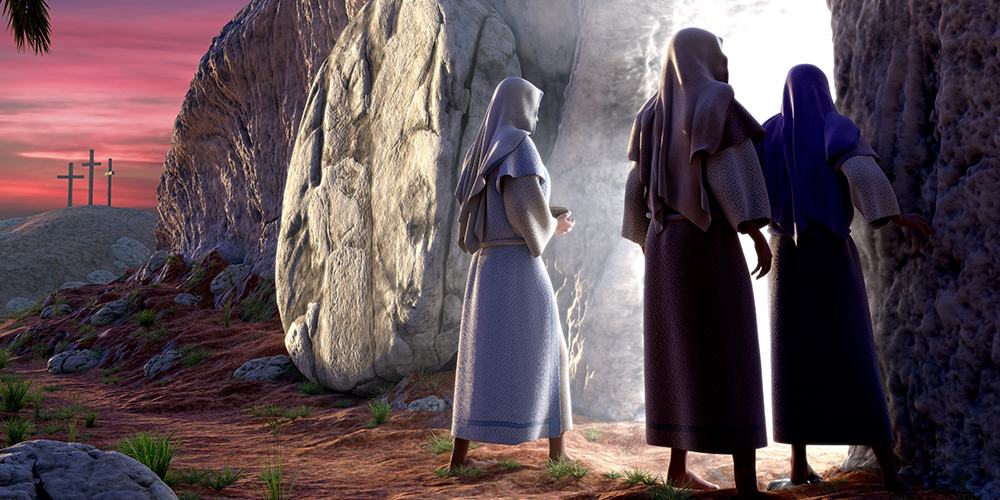
What caused the change in the lives and attitudes of the disciples after the death and burial of the Lord Jesus? The women who had prepared spices and ointments to anoint the body went to the tomb on the first day of the week but found it empty. Then an angel spoke to them, saying, “Why do you seek the living among the dead?” (Luke 24:5, ESV) Mary Magdalene and the women ran to tell the disciples. Peter, together with John, ran to the tomb. John arrived first and stood at the entrance, but Peter went in, and they both saw the linen that had wrapped the Lord’s body lying there, with the face cloth folded and set apart.
Others saw the Lord Jesus over the following days as well. The account of the two followers of our Lord who were walking back to their home in Emmaus provides a striking example of the sadness and fear among the disciples. Most had thought that the Lord was about to set up His kingdom and overthrow the yoke of Rome. These two men were surprised by another Traveller, and the explanation of the Scriptures that their “friend” taught them that day warmed their hearts as its truth was opened to them. During their meal, when the Lord broke bread with them, they finally realized it was the resurrected Lord Himself and raced back to Jerusalem to tell the disciples.
There are many intellectuals, and even religious organizations these days, that deny the resurrection of the Lord Jesus. However, there is more evidence for the resurrection available to scholars, lawyers, and religious leaders than there is for the authenticity of the writings of ancient philosophers and historians of the past. Most of the apostles and early believers died as martyrs, and as J & S Starkey stated in their book on Apologetics, “Nobody willingly dies for something they know is a lie.”1
The verses in 1 Corinthians 15:3-6 give clear teaching as to the importance of both the cross and the empty tomb: “That Christ died for our sins in accordance with the Scriptures, that he was buried, that he was raised on the third day in accordance with the Scriptures, and that he appeared to Cephas, then to the twelve. Then he appeared to more than five hundred brothers at one time, most of whom are still alive…” (ESV).
Paul then went on to confirm the importance of the resurrection with the statement: “If Christ has not been raised, then our preaching is in vain and your faith is in vain… and if Christ has not been raised, your faith is futile and you are still in your sins” (1 Cor. 15:14, 17, ESV).
Our sins have been dealt with, and new life is the result. “For as by a man came death, by a man has come also the resurrection of the dead. For as in Adam all die, so also in Christ shall all be made alive. But each in his own order: Christ the firstfruits, then at His coming those who belong to Christ” (1 Cor. 15:21-23, ESV). We are privileged to have the assurance that, as Christ rose from the dead, there will be a rapture of both the living and the dead, and so we shall be forever with the Lord.
ENDNOTES
- An Emmaus Worldwide Study Guide, Apologetics for Beginners.