
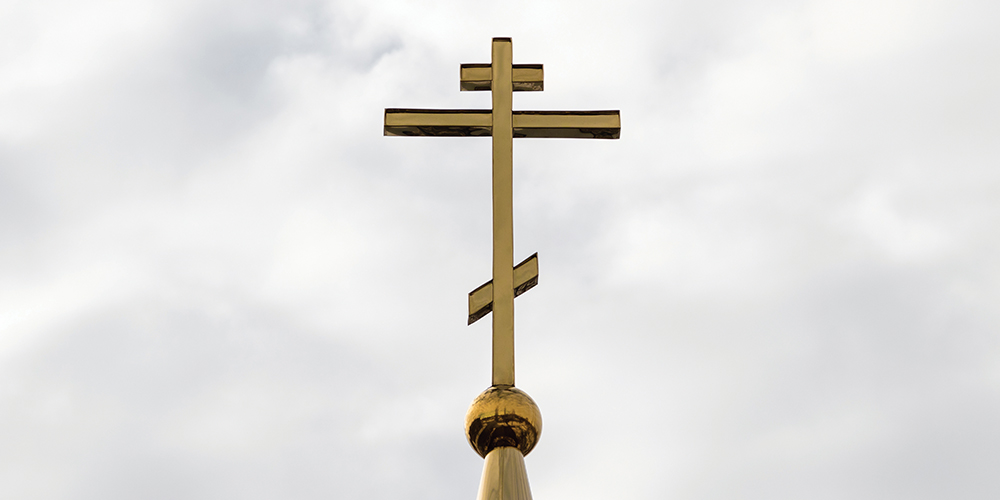
Recently, there has been growing interest in Orthodox Christianity in the United States and Canada, especially among young men. Several major news outlets have covered the trend, including the New York Post with the headline “Young men leaving traditional churches for ‘masculine’ Orthodox Christianity in droves,”1 the New York Times article “Orthodox Church Pews Are Overflowing With Converts,”2 and a BBC piece titled “Young US men are joining Russian churches promising ‘absurd levels of manliness’.”3
Anecdotally, Eastern Orthodoxy is discussed more frequently on YouTube, and several friends have mentioned that their children attended Orthodox services while in college. One young man who was baptized and attended our evangelical assembly eventually left to join the Orthodox Church, despite extended conversations that challenged some of its beliefs, several of which are addressed below.
While most Christians in the West are familiar with the Roman Catholic Church because of historical factors such as the Reformation and colonial expansion, the Eastern Orthodox Church has remained relatively mysterious to many Americans. Even amid the recent surge of interest, Orthodoxy remains a small segment of American Christianity. The New York Post article reported a 78% increase in converts in 2022 compared with pre-COVID levels in 2019. However, context matters: according to Pew Research Center’s 2023–2024 Religious Landscape Study, roughly 1% of U.S. adults identify as Orthodox.4 A decade earlier, Ryan Burge’s research showed a decline in practicing Orthodox Christians, from 817,000 in 2010 to 676,000 in 2020, with regular attendees dropping from 212,000 to 183,000.5 Thus, while the recent growth is noteworthy, it begins from a modest base. Nevertheless, it is worth examining why young men in particular are drawn to Orthodoxy, what their church teaches, and how those teachings compare with the Word of God.
Reasons for the Appeal
One clear takeaway from articles and videos is that many young men are seeking validation and purpose, which feels increasingly scarce in modern culture. The Post noted that while men and women historically converted in roughly equal numbers, vastly more men have joined since 2020. Father Moses McPherson, featured in the BBC article, expressed a common sentiment: “I don’t want to go to services that feel like a Taylor Swift concert. If you look at the language of the ‘worship music’, it’s all emotion—that’s not men.”
A second major attraction is the appeal of tradition and stability in a rapidly changing world. Orthodoxy offers ceremony, historic liturgy, and a claim to apostolic succession, positioning itself as an unchanging refuge. As convert Ben Christianson stated in The Post, “There is a sense of structure, of continuity… It’s the exact same. It hasn’t changed. It’s not going to change… I think there are a lot of Protestants who want a more traditional, grounded, historical faith.” These longings are understandable. Yet we must test whether Orthodoxy’s claims hold up against Scripture.
Problems with Orthodox Theology
Like the Roman Catholic Church, the Eastern Orthodox Church claims to be the one true church. Orthodoxy holds that Pope Leo IX effectively became the first Protestant when he excommunicated Patriarch Michael Cerularius of Constantinople in 1054. The split centered on disagreements over papal authority and the addition of the filioque (Latin for “and the Son”) to the Nicene Creed. Orthodoxy regards the first seven ecumenical councils as divinely inspired and unalterable. Because the Catholic Church attempted to alter the creed without the universal approval of the whole church, the Orthodox maintain that Rome departed from the inspired tradition and is therefore not the true Church.
Orthodox understanding of salvation (soteriology) closely parallels Roman Catholicism: salvation is a lifelong process involving faith and works, centered on participation in the seven sacraments—Baptism, Chrismation, Holy Eucharist, Confession, Holy Unction, Matrimony, and Holy Orders.6 The Orthodox Church rejects penal substitutionary atonement—the biblical teaching that Jesus satisfied God’s justice and wrath by becoming our substitute on the cross (Isa. 53:5-6, 10-12; Rom. 3:21-26; 2 Cor. 5:21).7 Instead, Orthodoxy emphasizes a therapeutic model of salvation, viewing sin primarily as a spiritual sickness or disease that needs healing and restoration of human nature through union with God (theosis), rather than primarily as a legal guilt that demands satisfaction of divine justice. This therapeutic approach is achieved through the sacraments and ascetic practices of the Church.
Baptism, whether as an infant or after conversion and the catechumenate, is said to bring new birth,8 immediately followed by Chrismation,9 which bestows the Holy Spirit. The Eucharist,10 which is central in Orthodoxy is understood through the doctrine of transubstantiation: the bread and wine become the literal body and blood of Christ. In order to have eternal life, it is taught that one must partake of the Eucharist (John 6:53-58), and because Christ’s physical body is not divided, His spiritual body, the Church cannot be divided. Therefore, if one is not baptized into the Orthodox Church, one is not truly born again; one does not possess the indwelling of the Holy Spirit; and one does not have access to the flesh and blood of the Lord that grants salvation. As Metropolitan Sotirios writes in his Orthodox Catechism, “Everyone must become a member of this Church to be saved. Everyone, without exception…Whoever does not follow the true faith is a heretic and is cut off from the Church.”11
This authority rests on the Orthodox view of Scripture and tradition. Metropolitan Sotirios explains:
“Oral revelation is Holy Tradition, and written revelation is Holy Scripture; and both Holy Tradition and Holy Scripture are equal. […] It is only Holy Tradition that can transmit the divine truths that are not written down in the Bible. Only Holy Tradition can correctly interpret Holy Scripture. When Holy Tradition is rejected and only Holy Scripture is accepted as the basis of our faith, as something to be interpreted by individuals, the unity of the faith is shattered.”12
The Orthodox Church also argues that it determined the biblical canon, so Scripture derives its authority from the Church. However, this reasoning does not hold. The apostle Paul declares, “For we can do nothing against the truth, but only for the truth” (2 Cor. 13:8, NASB). The Lord Jesus is the Truth (John 14:6), God’s Word is truth (John 17:17), Jesus is the Word (John 1:1), and His words will not pass away (Matt. 24:35). On what basis did the early church recognize which books would be included in the official canon of Scripture? Clearly, the decision was not made on the basis of the arbitrary authority of the church council, but rather on the evidence of the inspiration of the Scripture itself. If a particular book did not meet the criteria necessary to be accepted as divinely inspired, it would not qualify for inclusion. Therefore, the standard being used is Scripture itself, and thus the Word of God is again the final authority. This is the same standard that must be used to evaluate all the creeds and decisions of councils throughout the history of the Church, and this is what is meant by the term used by the Reformers, sola scriptura (Scripture alone). Scripture must be the final authority in matters of doctrine and interpretation (2 Tim. 3:16-17).
Based on this biblical understanding of the authority of Scripture, we must reject the Orthodox soteriology of faith and works and hold to salvation by faith alone, because of the grace of God through the Lord Jesus Christ, who bore our sins in His body on the cross (Acts 16:31; 1 Pet. 2:24; Gal. 2:15–21). We must also reject as unbiblical the worship, or veneration, of Mary, whom the Orthodox Church honors as “the salvation of the Christian faith,”13 the “acceptable sacrifice,” the “ewe-lamb of God without spot, the dove without blemish,” one whose “body was never subject to the taint of sin,” and through whom “we have been reconciled with God.”14
Additionally, the Orthodox tradition of venerating relics, which goes so far as to declare those who knowingly reject this doctrine to be under anathema,15 does not stand up to the test of Scripture (Ex. 20:4-6) or history,16 as there is no evidence of this practice in the early Church. Furthermore, the fact that a teaching can be traced back to the early Church does not mean that it is a true doctrine, since false teachers and Judaizers were already a problem in the apostolic era (Gal. 1:6–9). The same applies to the Orthodox doctrines of praying to the saints (1 Tim. 2:5), forbidding bishops to marry, fasting before communion (1 Tim. 4:3), toll houses after death,17 and prayers for the dead.18
Conclusion
The recent interest in Eastern Orthodoxy among young men reflects a genuine hunger for depth, masculinity, historical rootedness, and transcendence in a shallow and unstable age. Orthodoxy’s ancient liturgy, rigorous disciplines, and claim to unbroken tradition offer an attractive alternative to the emotionalism and constant innovation found in parts of contemporary Protestantism. Yet upon examination, its core teachings—particularly its understanding of salvation as a process mediated exclusively through the Church and its seven sacraments, its elevation of tradition as equal to and the interpreter of Scripture, its therapeutic model of salvation, and its rejection of penal substitution—depart from the clear teaching of the Bible.
The true Church is the body of all who hold fast to the truth of Scripture (Titus 1:9; Matt. 24:35). Scripture was not given to be interpreted ultimately by an institution, but by the illumination of the Holy Spirit to believers. Most importantly, the Bible gives believers wonderful assurance: “These things I have written to you who believe in the name of the Son of God, that you may know that you have eternal life…” (1 John 5:13).
If we have placed our faith and trust in the finished work of the Lord Jesus Christ—His substitutionary death on the cross and victorious resurrection—we already possess eternal life. It is not a future goal to be attained through sacraments and works, but a present reality received by grace through faith alone. This is the sure and certain hope of the Gospel.
Endnotes
- Schlott, Rikki, “Young Men Leaving Traditional Churches for “Masculine” Orthodox Christianity in Droves.” New York Post, 3 Dec. 2024, nypost.com/2024/12/03/us-news/young-men-are-converting-to-orthodox-christianity-in-droves/
- Graham, Ruth, “Orthodox Church Pews Are Overflowing with Converts.” The New York Times, 19 Nov. 2025, www.nytimes.com/2025/11/19/us/orthodox-christianity.html
- Ash, Lucy, Orthodox Christianity: Young US Men Joining “Masculine” Russian Churches. 24 May 2025, www.bbc.com/news/articles/c30q5l8d4lro
- “Orthodox Christians | Religious Landscape Study | Pew Research Center.” Pew Research Center, 26 Feb. 2025, www.pewresearch.org/religious-landscape-study/religious-tradition/orthodox-christian/
- Burge, Ryan P, The American Religious Landscape. Oxford University Press, 17 Mar. 2025
- Bratcher, Dennis, The Confession of Dositheus, Decree 13 (Eastern Orthodox, 1672)
- “An Orthodox Understanding of the Atonement. Jonathan Hill.” orthochristian.com/105429.html
- Athanassoula, Metropolitan Sotirios, Orthodox Catechism, Jesus Christ the Only Catechist. The Greek Orthodox Diocese of Toronto (Canada), July 2015, goarchdiocese.ca/wp-content/uploads/2017/01/Orthodox-Catechism-Basic-Teachings-of-the-Orthodox-Faith.pdf
- Ibid.
- Ibid.
- Ibid.
- Ibid.
- Theotokion from the Service of the Small Paraklesis. For full text see https://www.goarch.org/-/small-paraklesis
- “Entrance of the Mother of God into the Temple,” Orthodox Christianity, https://orthochristian.com/66118.html. This is one of the Twelve Great Feasts of the Eastern Orthodox calendar, and it is celebrated across Eastern Orthodoxy
- Richard Price, The Acts of the Second Council of Nicaea (787) (Liverpool: Liverpool University Press, 2020), 111–112
- Price, The Acts of the Second Council of Nicaea (787), 43
- Jeremy, Fr. “Toll Houses and the Fathers of the Church – Orthodox Road.” Orthodox Road, 24 July 2017, www.orthodoxroad.com/toll-houses-and-the-fathers-of-the-church/. Accessed 17 June 2026
- Bratcher, Dennis, The Confession of Dositheus, Decree 18 (Eastern Orthodox, 1672)