
Magazine:
“Therefore, it is of faith that it might be according to grace…” Romans 4:16
Though we may not agree with everything that emerged from the sixteenth-century Reformation, we can affirm that it redirected many back to scriptural truths still held by Bible-believing Christians today: Sola Scriptura, Sola Gratia, Sola Fide, Solus Christus, and Soli Deo Gloria.
Scripture Alone
The Bible teaches that there are only two faith systems: a false way that leads to hell and the true way that leads to God and eternal blessing. Though it appears in many forms, the core teaching of the false way is, “What shall I do to get to heaven?” False religions and cults share this same extra-biblical thinking, whether in the form of Christ’s work plus man’s good deeds or “my good works” alone. By contrast, Scripture teaches that a person is justified—declared righteous—by faith apart from works (Rom. 1:17; Gal. 3:1–14; Titus 3:5; Heb. 10:38).
Grace Alone
Grace and works cannot coexist. Romans 11:6 teaches that if salvation is by grace, it is no longer of works; otherwise grace is no longer grace. The moment we try to add human merit, grace becomes earned, even in part. A birthday gift illustrates the point: the giver bears the full cost, and if the recipient contributes, it is no longer a gift. We are saved by grace, for it is the gift of God (Eph. 2:8).
Faith Alone
Romans 3:28 says, “Therefore we conclude that a man is justified by faith apart from the deeds of the law” (cf. Gal. 2:16; Eph. 2:8–9). Any teaching that adds meritorious value to human effort and works clearly denies the plain teaching of Scripture that “all our righteousnesses [righteous deeds, NASB] are like filthy rags” (Isa. 64:6). Christ said, “This is the work of God, that you believe in Him whom He has sent” (John 6:29). When the Philippian jailer asked, “Sirs, what must I do to be saved?” Paul replied, “Believe in the Lord Jesus, and you will be saved” (Acts 16:30–31). Our good deeds have no currency in salvation. If our works were added to faith, they would still be contaminated by sin and could not justify us. The only accepted currency in heaven is Christ’s righteousness, received by faith in His finished work at Calvary.
Christ Alone
Christ paid the penalty for all sin at Calvary, and God demonstrated His acceptance of that finished work by raising Him from the dead (Acts 17:31; Rom. 4:25; Eph. 5:2; Heb. 9:12; 10:12–14). His work is complete and nothing can be added to it. Therefore, He alone is our Redeemer, Advocate, and Mediator (1 Tim. 2:5–6; Heb. 9:15; 12:24; 1 John 2:1). He alone is the object of our faith. If we add anything as a ground of acceptance with God, we imply that Christ’s saving work is insufficient. Galatians 6:14 says, “God forbid that I should boast except in the cross of our Lord Jesus Christ.” Each Lord’s Day, we remember Christ’s Person and work and echo the words of Samuel Rutherford: “The Lamb is all the glory of Emmanuel’s land.”
Glory to God Alone
We may ask many questions in heaven, but there is one question we will never ask, even of the most godly saint: “What did you do to get here?” Whether in creation or redemption, God must and will receive all the glory (Rev. 4–5). Not 99%, but 100% (Isa. 42:8). Salvation is completely the work of God (John 1:13), and all boasting in ourselves is excluded. Ephesians 2:9 says that salvation is “not of works, lest anyone should boast.” We praise God alone for His work at Calvary and for regenerating the one who believes in Christ.
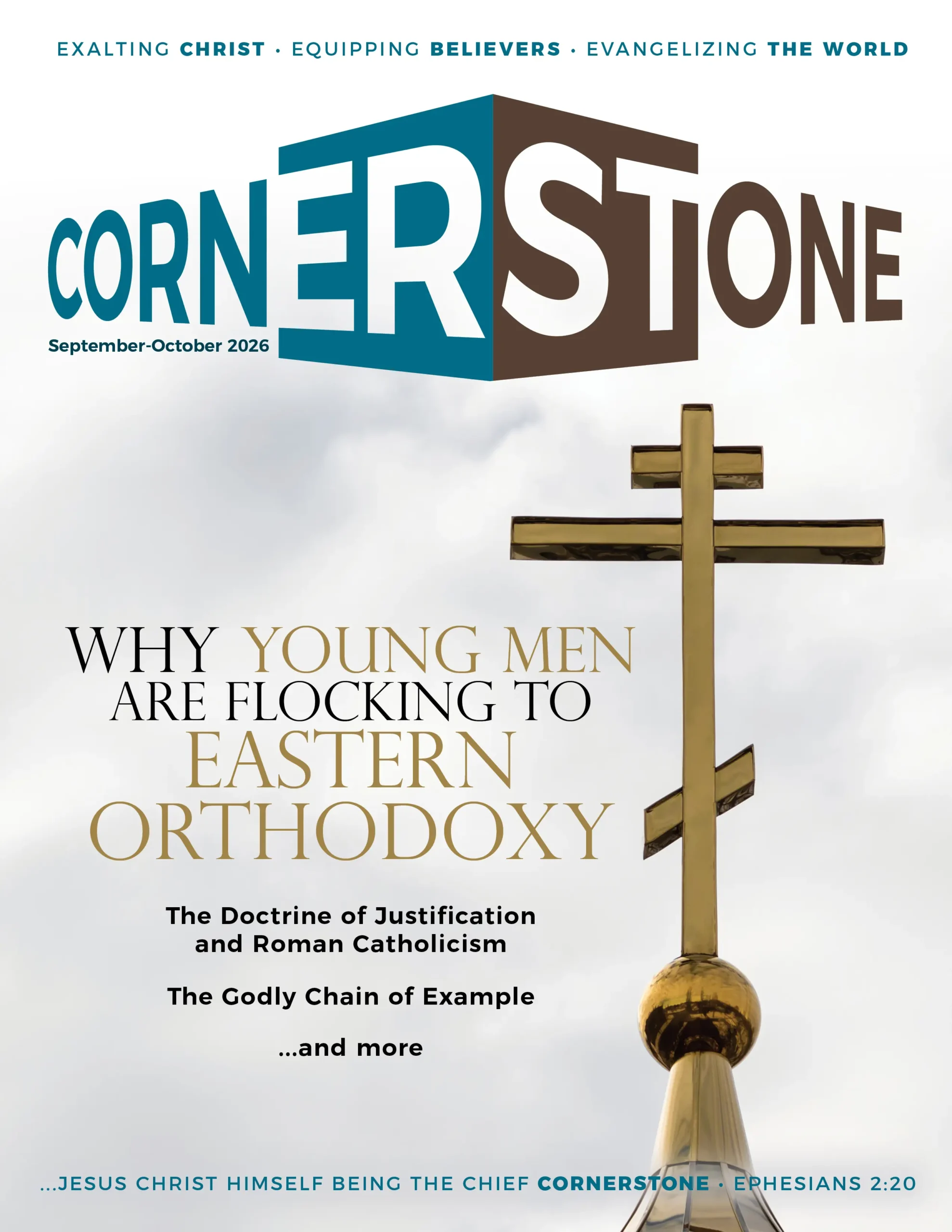
In the past few years, an increasing number of Gen Z and millennial men have turned to Eastern Orthodoxy and Roman Catholicism. Tragically, this trend is drawing many unbelievers away from the simplicity of the gospel, while believers have their spiritual growth stunted as they move away from the plain teaching of Scripture. According to God’s Word, believers must worship the Lord “in spirit and truth” (John 4:24). May we all “contend earnestly for the faith which was once for all delivered to the saints” (Jude 3).
George T. Ferrier
Search Magazines Articles:
2026:


2025:




2024:



2023:

2022:
2021:




2020:



2019:




2018:



2017: